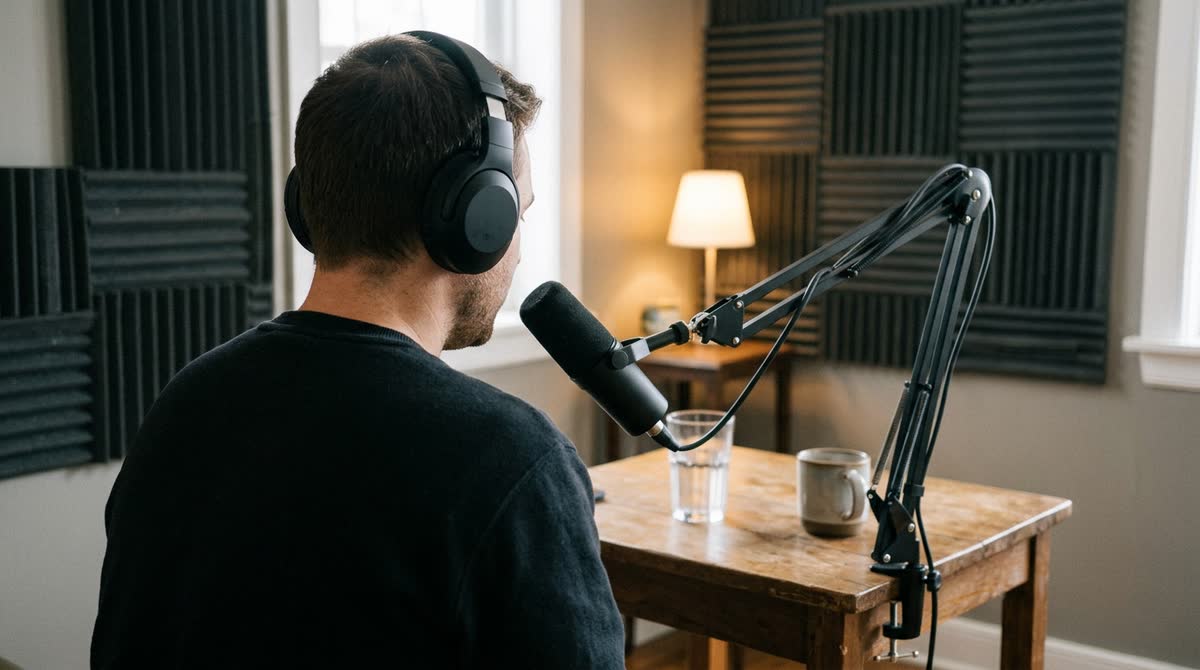
Yes, they can help, mainly when the appearance leaves a public web page with text that names you and says what you do. In one study, AI search engines cited third-party pages far more often than brand-owned or social content, so a well-documented interview can add something your own website cannot, while an episode with no show notes or a quote with no context leaves an assistant little to repeat.
Nobody can promise that an assistant will name you after any single appearance. What you control is whether each appearance leaves something readable, specific to your field and easy to find.
Why do pages on other people's sites matter to AI assistants?
When ChatGPT, Claude, Gemini or Perplexity search the web before answering, they pick a handful of pages and build the answer from them. Many of those pages belong to someone other than the person or company in the answer. The study of AI search engines mentioned above, submitted in September 2025, found a "systematic and overwhelming bias" toward earned media, meaning third-party, authoritative sources, over brand-owned and social content, in contrast to the more balanced mix in Google's results.
Your own site still matters. In our measurement of 20 October 2026 for an orthopaedic practice in Bonn, competing practices' own websites were the most cited sources, and the directory jameda.de was cited in 12 answers. Both kinds of page counted: practices describing themselves, and an outside directory describing them.
For a person, the logic is the same. Your website says what you are expert in, in your own words. An interview page, a podcast episode page or an article that quotes you says it from the outside. When an assistant answers "who is a good advisor on X", it has more to work with if several independent pages connect your name to X, and less if the only page that does is yours.
Which podcast and press formats leave text an assistant can read?
Answers are built from text on pages. Google's page on AI features and your website (last updated 10 December 2025) says that to be shown as a supporting link in AI Overviews or AI Mode, a page must be indexed and eligible to appear in Google Search with a snippet, and it lists making sure important content is available in textual form among the practices that still apply. An hour of audio with a two-line description is, for this purpose, a two-line page.
| Format | What text it leaves | What to ask for |
|---|---|---|
| Article that interviews or quotes you | Your name, role and quote, in the publication's words | One sentence on your field, not only your job title |
| Podcast episode page with show notes | Guest name, episode title, a summary, links | A summary of the topics you covered and a link to your site |
| Transcript on the show's own website | The whole conversation as a web page | The transcript on the episode page, or linked from it |
| Transcript inside a podcast app | Text for listeners in that app | Your name spelled correctly in the episode description |
| Audio or video file with a title only | Little beyond the title | Show notes at the very least |
| Guest article under your byline | Your own explanation of your field, on another domain | An author bio that states your specialty |
On podcast apps, Apple automatically generates transcripts after a new episode is published, and the same page advises including host and guest names in the show and episode descriptions so the names are spelled correctly in the transcript. Apple describes this as a feature of the Apple Podcasts app. A transcript or detailed show notes on the show's own website is a separate web page, and that page is the one worth asking the host about.
For press, the useful part is the paragraph around your quote. "Said Jane Smith, a consultant" ties your name to nothing in particular. "Said Jane Smith, who advises mid-sized logistics firms on customs audits" ties it to a field in the words a person might type into an assistant.
How do you make a mention specific to your field?
An assistant that cites a page can only work with what that page says, so the work happens before the page is written. Research on generative search points the same way. In the GEO study presented at KDD 2024, the top-performing methods were adding citations and quotations from credible sources and replacing vague discussion with statistics; they improved a page's visibility in generative engine responses by 30-40% over the unchanged page on the study's position-adjusted word-count measure, while keyword stuffing offered little to no improvement. That study changed the pages themselves, not mentions of people, but it points the same way: concrete quotes and figures gave a page more weight in answers, repeated keywords did not.
In practice:
- Send a two-sentence description before you record or meet the journalist. Write it the way you want it to appear in the show notes or the article: your name, what you do, and for whom.
- Use the same name and the same description of your field everywhere. Show notes, author bios, your own site and your profiles should agree, so every page connects your name to the same topic.
- Bring one quotable, concrete point. A method you use, a mistake you see clients make, a figure from your own work that you can stand behind. Journalists and hosts quote what is specific.
- Ask for a link to your own site in the show notes or the author bio, so the outside page and your page point to each other.
- Choose shows and publications that cover your field. A mention on a page about your topic connects you to that topic. A mention in a general roundup connects you to very little.
If you are building the rest of your presence as an expert, How to Get ChatGPT to Recommend You as an Expert covers your own pages in more detail. If you also post on LinkedIn and X and want those posts to stay on the same topics as your interviews, our separate LinkedIn and X drafting tool drafts posts in your voice on topics you choose, and you approve or edit each one before it goes out.
Which appearances are worth your time?
Before you say yes to an invitation, look at what the show or publication left behind for its previous guests. Three questions sort most options:
- Does each episode or article have its own public page? Open a few older ones. If the page names the guest and summarises the conversation, yours will probably get the same treatment.
- Is there text beyond the title? Show notes, a transcript, a written recap or a quote-rich article all count. A feed of audio files with one-line titles does not leave much.
- Can anyone open the page? A page behind a login or hard paywall may not be readable by the tools an assistant uses to fetch it, so prefer outlets whose articles open freely.
A small, specialist show with a detailed episode page can do more for this purpose than a large show that publishes audio only. The large show may still be worth doing for its listeners. Just do not count on it to put your name into AI answers unless it leaves text.
How do you check which of these pages assistants actually cite?
Do not judge by downloads or by how the episode felt. Ask the assistants directly and read their sources.
- Write the questions a client would ask. Mix topic questions ("who advises logistics firms on customs audits?") with your name ("who is Jane Smith?").
- Ask each question in ChatGPT, Claude, Gemini and Perplexity with web search on. When Claude searches the web, every response includes citations, so you can check its sources yourself. Whenever an answer lists sources, open them and note which ones are your podcast and press pages.
- Ask each question more than once. Asked the same question three times, an assistant often names different businesses. When we measure, we count a business as named for a question if any of three asks names it, and compare checks only on the same questions and the same number of asks.
- Write down three things per answer: whether you were named, which pages were cited, and whether any of your appearances was among them.
- Repeat after new appearances with the same questions and the same number of asks, so the comparison means something.
If an appearance never shows up as a source, search for the exact episode or article title in the assistant. If it cannot find the page by its own title, it is unlikely to cite it for a topic question. How to Check If ChatGPT, Claude, Gemini and Perplexity Name You walks through this check step by step.
If you run a company and would rather have this done for you, ItGrows works on making businesses visible in AI answers and measures whether ChatGPT, Claude, Gemini and Perplexity name them. Our guarantee for companies: in 90 days, AI assistants will name you more often than on launch day — or we work for free.
What mistakes make an appearance invisible to assistants?
- Audio only. No episode page, no notes, no transcript on the web.
- A misspelled or changed name. If the show spells you differently from your own site, the two pages do not obviously describe the same person.
- A job title instead of a field. "Founder" or "consultant" says nothing about what you are expert in.
- Mentions that live only in a social post or a newsletter email. The September 2025 study above found AI search leaning toward third-party, authoritative sources over brand-owned and social content, and an email that is not also published on the web has no public page at all.
- Treating one appearance as the finish line. Answers vary between asks, so one interview is one more page, not a switch.
Frequently Asked Questions
Does a podcast appearance help if there is no transcript?
It can, if the episode has its own web page with show notes that name you and describe your field. With only an audio file and a short title, there is very little text for an assistant to work from. Ask the host for a written summary at the very least.
Is a press mention better than an article on my own website?
They do different jobs, and you need both. Your site is where you describe yourself in full; a press mention is an independent description, and the September 2025 study cited above found AI search leaning toward such third-party sources. Make sure both say the same thing about your field.
Will one big interview get me named by ChatGPT?
No one can promise that. An assistant answering a question about your field draws on several pages, and its answers vary from one ask to the next. Treat each appearance as one more readable page that ties your name to your field, and check the result with repeated asks.
How do I know which of my appearances an assistant used?
Ask it the questions a client would ask with web search on, then open the sources listed with the answer. Ask each question more than once and keep the same questions for later checks. If an appearance never appears as a source, check whether the assistant can find that page by its exact title.